
Organic inputs, one pre-measured pod
What goes into a BioPod, what each ingredient does for a plant, how the compartments release in stages, and what the shell is made of.
What feeds your plant, and why
Beneficial soil microbes
The bacteria and fungi of healthy, living soil. In a pot they help roots take up what is already there, and they keep the soil from going lifeless between feedings.
Sea kelp
One of the oldest soil amendments there is. Kelp carries trace minerals and natural plant compounds that support root growth and help plants cope with stress.
Humic acid
Comes from natural organic matter. It helps soil hold on to nutrients and water so they stay available to the roots instead of washing straight through the pot.
Plant proteins and nitrogen
Nitrogen is the nutrient behind leaves and green growth. In BioPod it comes largely from plant proteins, which break down slowly in the soil, so the plant is fed over weeks instead of in one hit.
Phosphorus
For roots, flowers and the energy a plant uses to grow. Container plants cannot go looking for it, so it has to be in the pot.
Potassium
Overall strength: how a plant moves water, stands up to heat and cold, and keeps its stems firm.
Essential micronutrients
The nutrients plants need in small amounts, including calcium for new growth and strong cell walls. Missing one shows up as odd leaf colour long before anything else.
Organic inputs in a balanced blend, no synthetic fertilizers, pre-measured into the pod. We do not publish ratios.
Compartments that release in stages
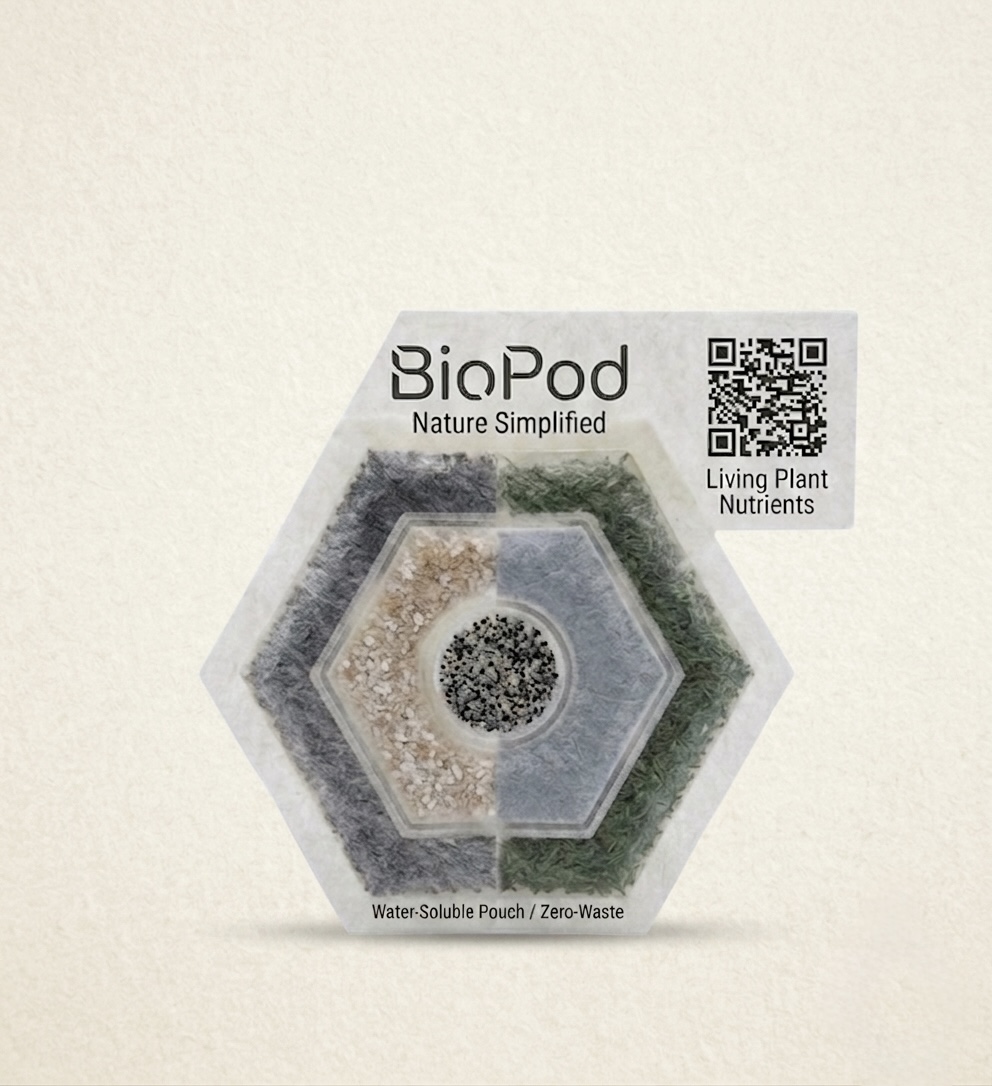
The pod is divided into compartments, and they do not all let go at once. Fast-acting minerals come first for visible greening in the first days. Nitrogen from plant proteins releases over the following weeks as soil life breaks it down. The microbes establish in the root zone and keep working between feedings. That is why one pod feeds for 4 to 6 weeks instead of a spike and a crash.
Cellulose paper that dissolves in 30 to 90 seconds
The founder tested three shell materials through hands-on, bench-scale experimentation before choosing the one that goes into every pod.
PVA, the dissolvable synthetic polymer used in detergent pods, dissolved well. But PVA is still a petroleum-derived polymer, and dissolving is not the same as biodegrading. What happens to it afterwards depends on conditions downstream, and the science on its full breakdown is still debated. As an environmental scientist, the founder chose not to put a debated polymer into living soil. Plant-starch shells failed on humidity and shelf life. Cellulose paper passed everything: soil safety, moisture stability, shelf life, cost, and biodegradability.
The selected shell is cellulose paper. It is fully biodegradable and dissolves in the soil within 30 to 90 seconds when watered, leaving no residue.
What goes into every pod
Everything a container plant needs for 4 to 6 weeks, from organic inputs, in one cellulose shell. Nothing to measure, nothing left in the soil.
Claims we can stand behind, and nothing else
BioPod was designed by an environmental scientist. That shows up less in big words and more in what is missing from this page: no invented numbers and no promises about results we have not measured ourselves.
BioPod is solely owned by its founder, with written confirmation that no institution holds any claim over its formulation, product design, or business.
Plant food you can actually read
Reserve a pack at the launch price. Nothing is charged until it ships.